Pub.lished Movie Reviews
A Clockwork Orange (1971)
"Along the way, Alex has been set apart as the hero by making his victims less human than he; the picture plays with violence in an intellectually seductive way-Alex's victims are twisted and incapable of suffering. Kubrick carefully estranges us from these victims so that we can enjoy the rapes and beatings. Alex alone suffers. And how he suffers!" - Pauline Kael
"A Clockwork Orange," based on Anthony Burgess's novel of the same name, is a cinematic masterpiece. Burgess made a brilliant move by inventing his own slang, giving his futuristic story a timeless appeal. When Stanley Kubrick brought the novel to the big screen, he effectively created his own line of furniture. The use of humanistic furniture in the film added to its timeless visual appeal.
The story revolves around Alex and his droogs, or gang, who engage in a bit of the old ultraviolent - gang fights, rapes, and pillages of local homes. These bands of kids run wild, displaying a complete lack of moral compass and remorse. The narrative introduces a new, highly controversial treatment designed to instill a deep aversion to any form of violence, even self-defense.
"A Clockwork Orange" presents an unfiltered view of a potential future where children grow into uncontrolled psychopaths, a path they sometimes seem to lean towards. The film also poses thought-provoking questions about the delicate balance between individual freedom and society's need to control individuals to ensure safety.
Despite being filmed in 1971, the movie's themes and questions remain relevant today, giving it a timeless quality. It feels as fresh and significant today as it was when it first premiered. It's a testament to the genius of both Burgess and Kubrick that "A Clockwork Orange" continues to captivate and disturb audiences, even after half a century.
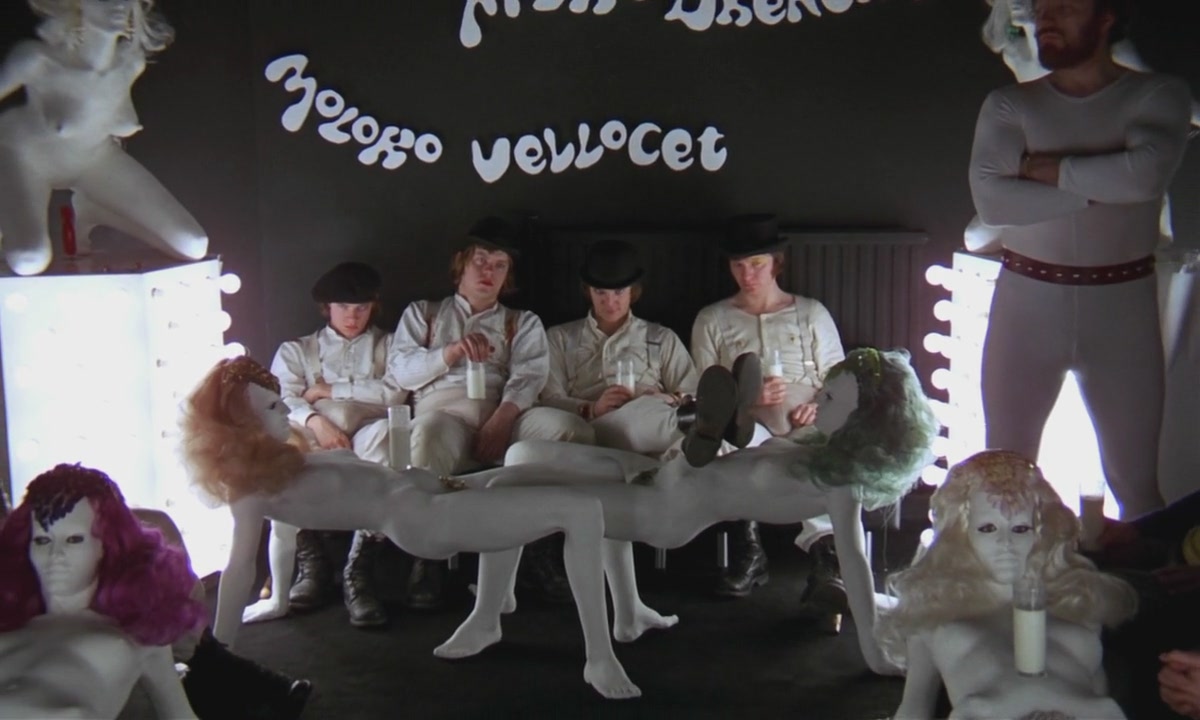
"Goodness is something chosen. When a man cannot choose he ceases to be a man."
- You are under the age of 18, as this is a movie restricted to adults only due to intense scenes of violence and sexual content.
- You have a low tolerance for graphic violence or sexual content. There are scenes in this movie that can be considered disturbing.
- You struggle with themes of moral ambiguity. The movie purposefully blurs lines between good and evil.
- You prefer Hollywood-style endings where everything is tied up nicely. "A Clockwork Orange" has an ambiguous and thought-provoking ending.
Warning: The following may contain spoilers:
What's the deal with "A Clockwork Orange?"I mean, here's a guy, Alex, who loves Beethoven, yet he's as violent as they come! You know, in my day, listening to classical music was a sign of sophistication. But in this movie, it's like a soundtrack to a bar brawl! Who knew that Beethoven could be the ultimate fight music?
And those costumes? It's like Halloween every day in dystopian Britain. And I thought New York had weird fashion trends!
Pulp Fiction (1994)
Buffs of "A Clockwork Orange" will likely enjoy "Pulp Fiction" due to both films' unconventional narrative structures, unique stylization, and exploration of violence. Both films are characterized by their distinctive directorial styles, with Stanley Kubrick's meticulousness and Quentin Tarantino's cult aesthetic offering a visually impactful experience. Additionally, both movies challenge traditional notions of morality and societal norms, pushing the boundaries of their respective genres with dark humor and a raw portrayal of brutality.
American Beauty (1999)"A Clockwork Orange" and "American Beauty" are thought-provoking films that explore deep social and psychological complexities. They share a darkly satirical approach to societal norms, with "A Clockwork Orange" critiquing behavioral conditioning and state control, and "American Beauty" satirizing the American middle-class notions of beauty and satisfaction. Both films are punctuated by striking visuals, unconventional narratives, and masterful performances, making them appealing to viewers who appreciate nuanced and layered storytelling.
The Shining (1980)Directed by Stanley Kubrick, same as A Clockwork Orange, The Shining is a masterpiece of psychological horror. The movie focuses on a writer who takes a job as a winter caretaker at an isolated hotel with a dark past. Jack Nicholson delivers an iconic performance, and the claustrophobic setting coupled with the eerie music adds to the chilling effect. This film will appeal to those who appreciate Kubrick's unique style and intense character studies.
Memento (2000)Buffs of "A Clockwork Orange" would appreciate "Memento" for its innovative narrative structure and exploration of complex themes such as morality, identity, and the nature of reality. Like "A Clockwork Orange," "Memento" is a psychological thriller that challenges conventions, with its unconventional storytelling method - a non-linear, fragmented narrative that mirrors the protagonist's memory loss. Both films also share a dark and disturbing undertone, exploring the psychological depth of their characters and posing thought-provoking, moral questions to the audience. Therefore, the intellectual stimulation and emotional intensity found in both films would appeal to the same audience.
Donnie Darko (2001)Those who appreciate A Clockwork Orange's subversive exploration of morality, dystopian society, and psychological complexity will also be drawn to Donnie Darko's similar themes. Both films delve into the dark side of the human psyche and the struggle against societal norms, with an abstract narrative approach that leaves room for interpretation and discussion. The unique blend of horror, science fiction, and dark humor in both movies, combined with their distinctive cinematic style and memorable characters, make them appealing to viewers who enjoy challenging, thought-provoking cinema.
Blade Runner (1982)If you enjoyed the dystopian feel and moral ambiguity of A Clockwork Orange, Blade Runner is a perfect choice. Directed by Ridley Scott, the movie is renowned for its outstanding futuristic aesthetic, nuanced character performances, and philosophical themes. Based on a Philip K. Dick's novel, its plot revolves around a man hunting down genetically engineered beings. Equally thought-provoking and visually striking, it's a movie that will surely fascinate you.
2001: A Space Odyssey (1968)"A Clockwork Orange" and "2001: A Space Odyssey" are iconic films directed by Stanley Kubrick, known for his innovative storytelling and technical mastery. The films share a similar aesthetic and thematic depth, exploring complex subjects such as human nature, morality, and the implications of technological advancement. Both films boast stunning visuals, innovative use of music, and a narrative style that invites viewers to delve into their hidden meanings. If you appreciate the dark, thought-provoking narrative of "A Clockwork Orange," you'll likely enjoy the philosophical exploration and visual spectacle of 2001: A Space Odyssey.
Monty Python and the Holy Grail (1975)Connoisseurs of "A Clockwork Orange" may also love "Monty Python and the Holy Grail" because both films challenge conventional storytelling with their dark, absurdist humor and satirical commentary on society. Each movie presents a unique, surreal world filled with memorable, eccentric characters, and they both use their unconventional narrative style to provoke thoughtful discussions about morality and human nature. While "A Clockwork Orange" focuses on a dystopian future with a violent protagonist, "Monty Python and the Holy Grail" satirizes the romanticized image of the chivalrous knights of the Arthurian legend, both providing distinctly British takes on their respective genres.
Taxi Driver (1976)Those who love "A Clockwork Orange" (1971) will also love "Taxi Driver" (1976) because both films revolve around anti-heroes and delve into the darker aspects of human nature. Each film explores themes of violence, alienation, and moral ambiguity, utilizing distinctive cinematography and compelling performances. Stanley Kubrick's surreal aesthetic in "A Clockwork Orange" and Martin Scorsese's gritty portrayal of New York in "Taxi Driver" both present a unique, intense cinematic experience. The controversial subjects and psychological depth of the characters in both films engage the audience in a thought-provoking journey.
Trainspotting (1996)Fans of "A Clockwork Orange" will also appreciate "Trainspotting" due to their shared exploration of dark themes, rebellious youth, and societal disillusionment. Both movies employ a stylized, unconventional narrative, filled with provocative and disturbing imagery, creating an immersive, albeit discomforting, viewing experience. The films’ protagonists are anti-heroes, whose journeys provide a commentary on the societal issues of their times. The use of unique, localized dialects in both films also adds to the authenticity and depth of the characters and their environments.
A Scanner Darkly (2006):Another adaptation of a Philip K. Dick story, A Scanner Darkly employs an arresting animation technique to narrate a haunting, psychologically intricate plot about surveillance, substance use, and identity. Its surreal tone and contemplative themes align well with the essence of A Clockwork Orange. With a stellar cast involving Keanu Reeves, Winona Ryder and Robert Downey Jr., it guarantees an absorbing watch.
Requiem for a Dream (2000):Directed by Darren Aronofsky, this movie succinctly encompasses the psychological turmoil and dark undertones that are characteristic of A Clockwork Orange. It ventures into the horrors of addiction, consequent despair, and inevitable downfall of characters with an unflinching gaze. Just as Kubrick's film doesn't hesitate to confront dark themes, Aronofsky's movie is also a profound exploration of the human condition.
David Lynch's Blue Velvet (1986):Blue Velvet is an ideal recommendation if you're drawn towards the disturbing and bizarre aspects of A Clockwork Orange. Directed by David Lynch, this film explores the darker side of an idyllic American town. With engaging performances from Kyle MacLachlan and Isabella Rossellini, this neo-noir mystery dives deep into the themes of innocence, corruption, and surrealism.
Remember, as with all films, personal preference will always come into play, but these selections should give you something to sink your teeth into. Enjoy your movie marathon!Like this? Then click here to see more scifi movies